

The colloid science behind the architecture - DLVO electrostatics, not HLB arithmetic.
The science of NanoBase™.
NanoBase™ is a tri-domain nano-colloidal architecture held together by engineered interfacial charge, described by DLVO theory, and characterised by Dynamic Light Scattering. This is the mechanism, the measurement, and the boundary between what we publish and what stays proprietary.
Held by charge, not by surfactant balance.
Griffin's Hydrophilic-Lipophilic Balance (HLB), published in 1949, holds an emulsion together by matching surfactant numbers to an oil phase. NanoBase™ works differently: the dispersed nanoscale structures are designed to carry a strong like charge, so they repel one another and the population is kept apart. Stability is designed to come from the interface itself rather than from a ratio that has to keep holding.
DLVO theory
Named for Derjaguin, Landau, Verwey and Overbeek. It describes colloidal stability as the balance between electrostatic repulsion and attractive van der Waals forces between particles - the physics governing an electrostatically stabilised nano-architecture.
Electrostatic stabilisation
Stabilisation achieved by placing a strong like charge on the dispersed structures so mutual repulsion keeps them apart, as distinct from steric stabilisation and from HLB surfactant matching. It is the mechanism underneath the tri-domain architecture.
Where HLB reaches its limits
HLB assigns emulsifiers a number from 0 to 20 describing water/oil affinity. It governs phase stability in a container - it does not address particle size, distribution or delivery, and was never designed to.
Three domains in one continuous phase.
Tri-domain architecture engineers three distinct nanoscale domains together inside a single continuous water phase, so payloads of different chemistry partition into the compartment that suits them.
Nanocolloidal domain
A sub-micron dispersion of oil droplets in water, stabilised at the droplet interface, used to carry oil-soluble material.
Nanoliposomal domain
A carrier compartment formed from a phospholipid bilayer enclosing an aqueous interior, suited to amphiphilic and bilayer-associating material.
Nanomicellar domain
A carrier compartment formed from surfactant assemblies that solubilise material which will not dissolve in either the oil or the water phase alone.
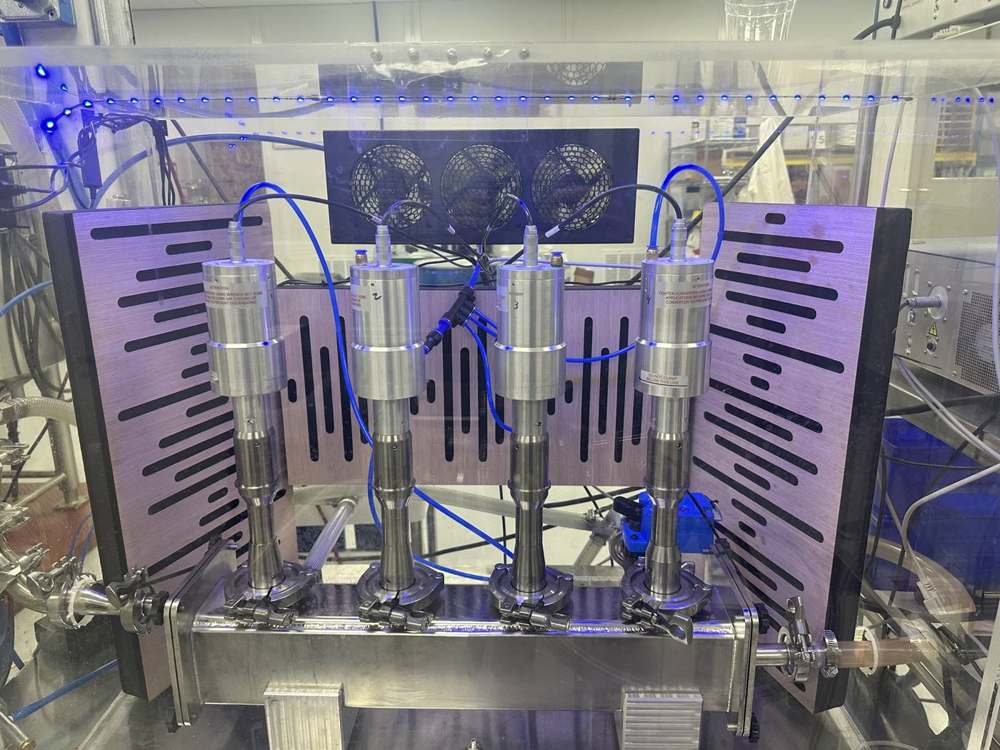
Inside the Pensive Beauty® nanoscience lab. The nanoscale structure is engineered and characterised upstream, so the finished product is built cold, downstream, with conventional equipment.
What we measure, and how we read it.
Z-average particle size
The intensity-weighted harmonic mean particle size reported by Dynamic Light Scattering, and the standard figure quoted for a colloidal population. It should always be read together with the polydispersity index - the mean alone can conceal a coarse tail.
Why approximately 185 nm matters
Sub-micron engineering at this scale allows actives to be held in a structured, designed dispersion rather than in coarse macro-emulsion droplets. Distribution uniformity matters as much as the mean, which is why characterisation is performed across multiple scattering angles rather than reported as a single number.
What is published, and what is not.
- The architecture and its electrostatic stabilisation mechanism
- Particle characterisation and the performance envelope
- A citable identifier: DOI 10.5281/zenodo.18616576
- Composition and ingredient identities
- Processing parameters and manufacturing method
- Internal release specifications
The particle size you specify is the particle size we characterise - the evidence is open; the recipe is ours.
NanoBase™ and nanoscience terminology.
Tri-domain nano-colloidal architecture
A system in which nanocolloidal, nanoliposomal and nanomicellar domains are engineered together inside one continuous water phase so different payload chemistries partition into the compartment that suits them.
Electrostatic stabilisation
Stabilisation by like-charge repulsion between particle surfaces, as distinct from steric stabilisation. Formalised by DLVO theory.
DLVO theory
Derjaguin-Landau-Verwey-Overbeek: colloidal stability as the balance of electrostatic repulsion and van der Waals attraction.
Hydrophilic-Lipophilic Balance (HLB)
A 1949 Griffin system assigning emulsifiers a 0-20 number for water/oil affinity. Governs phase stability, not particle size, distribution or delivery.
Z-average particle size
The intensity-weighted mean particle diameter reported by Dynamic Light Scattering.
Polydispersity index
A dimensionless measure of the width of a particle-size distribution. NanoBase™ is trimodal by design, so a single dispersity figure is not a quality metric for this architecture in isolation; read alongside the mean.
Nanocolloidal domain
A sub-micron oil-in-water dispersion stabilised at the droplet interface, carrying oil-soluble material.
Nanoliposomal domain
A phospholipid-bilayer compartment enclosing an aqueous interior, suited to amphiphilic and bilayer-associating material.
Nanomicellar domain
A surfactant-assembly compartment that solubilises material insoluble in either the oil or water phase alone.
Modular nano-colloidal Architecture
A cosmetic raw material engineered and characterised upstream and supplied as the finished continuous water phase, completed downstream with room-temperature mixing.
Cold-processable base architecture
An architecture requiring no heating and no nano-processing downstream, because the nanoscale structure is created before it is supplied.
Interfacial coverage and payload ceilings preprint (Zenodo, 2026) DOI 10.5281/zenodo.21971474
Architecture you can cite.
Bring us the product you want to build. We will show you what it looks like engineered properly.
team@pensivebeauty.com · 508-206-6500 · Pensive Beauty Labs, Seffner, FL